An Earthen Queen

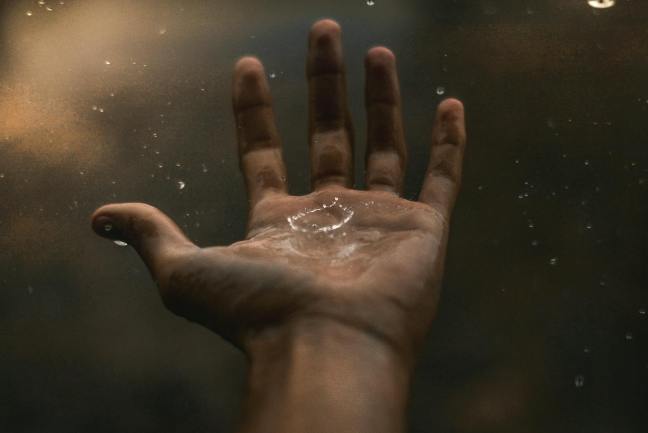
Its rained for days.  Weeks really.

The sky a dull grey, clouds looming, hour after hour. There has been the odd gap, a shaft of blue but it has been rare. It has not been apocalyptic rain, not sheets of water pounding into the earth. It has been a slow tedious drizzle, falling out of the sky. A steady, stealthy, beat, bent on a ponderous breaking of the spirit, rather than a thrashing of the soul.

It has fallen on pavements and rooftops, on hospitals and schools, in churchyards and backyards and roads and playing grounds. The world is now soggy and damp.

I have not been outside much.

I want to write to the newspaper, to open the machine and type in the words. Tell them this isn’t the first time, this has happened before, centuries ago. I can’t. How would I know that? Its before proper records began.

There are several of them, of us. Spread out across the country, all with the same thought, somewhere out there, something, someone, has called the rain.

English is one of the few languages where the word queen does not derive from the word king. This is why. This queenness thing, born of the land, eked out of the soil. Britain and its earthen queens, I remember them all. Not all queens but all of them queens.

Victoria  was not one, nor the last Elizabeth, although we someone times wonder about both. The Elizabeth before that one, she was one of ours. There was Boudica with all her wildness. She was born this way too, with the rain.  And Aethelflaed, the fearless Mercian prodigy. Each of them, born ready for war.

And this one will be too, a new queen, forged from British soil, literally.

I take out ancient robes, dust them down, ready to begin the journey, to seek out the child, if indeed it is given up as a child.

The rain, a new queens insatiable appetite for the land to nurture her at birth, to give her sustenance. She might be born fully formed. She is a queen with the clouds and the land as her womb and the rain as her milk. Formed in the mud and chalk and the clay, features fine and chiseled by the roots of Oak and Beech, Birch and Ash, Hazel and Blackthorn, succoured on rain tinged with the tang of nettles and blackberries, wild garlic, and wild strawberries.

I wonder what this one would be like, a war monger, or a woman of peace. There has never really been a woman of peace born this way, of the earth itself and not the womb. There is something about this birth, this island, that births them ready for war, even Elizabeth. So almost certainly a war monger, leader of men  but a slayer of men. A warrior queen.

What will that look like in the 21st century?

Will she be born like the others? Boudica was born fully grown. It had rained for months and we stood knee deep in mud as she writhed and fought and finally extricated herself from whatever held her in the earth. She arose like a goddess before us. Her reign short but bloody.

Elizabeth had a more even temperament, she came out of the earth as a child, yet still she had found war. I remember her standing on the banks of Tilbury, still remembered for her urgent message to soldiers, bring me blood. And Aethelflaed, who was born on the winds to the west and stayed there to slay all who defied her. She fought like a mad thing and was the best with a sword I have ever seen.

But it is a different world now. What if CCTV finds some naked woman emerging from the mud and screaming she is queen?

As I start to drive I can smell it already. Its primal this birth, wild, a queen, a thing, caked in mud and grime emerging from the land, an unfurling of limbs from the murky darkness of soil and clay. The rain will stop, the weather will calm and she will be here.

Then if we are lucky there will be days of sunshine before the days of blood. I can feel her, I can feel her power. She is coming. I look at the rain, at the way it is falling, called from the sky for a fickle mistress. I want to pray but prayer has long since left me.

If this must be bloody, let it be short. Let the days of sunshine be long. Let the rain stop. Let there be calm. Before the storm. Because I can feel the power of the storm, of its attraction and I can tell, this one is more Boudica than Elizabeth and the ground that is soaked in mud, will dry and then at her whim, be soaked in blood.

If you like this, hit the button. I wrote it as prose, but am not sure it would not make a better poem. If I was going to write a novel, I think this is how I would start it.
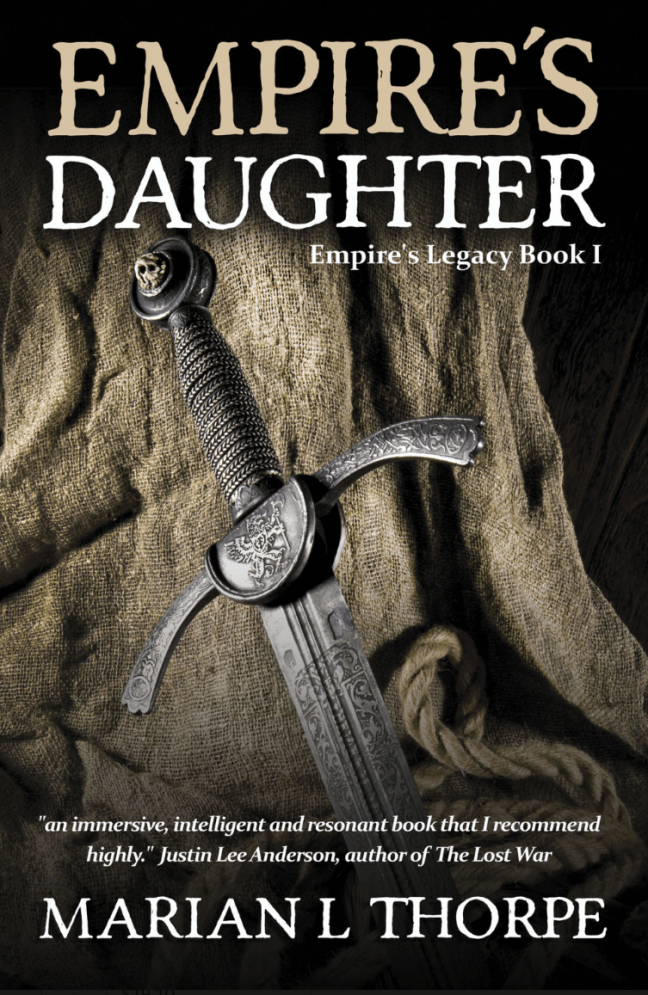
Review: Empire’s Daughter

I really enjoyed this book. The narrative is well paced and whilst it’s part of a wider series, it stands on its own as a story. The tension builds nicely in the first part, with more emotional resolution in the second. I liked the main character, and you get a real sense of the physicality of the lifestyle in the early parts of the book.

The scene setting is really good, just real enough that you can picture it in your head, but not too overdone. The writing is sparse in some ways but it fits the mood of the book. Its well drawn, engaging and absorbing. At its centre is an idea that has its roots in a reality that we rarely hear about, there were small women only settlements for various reasons.  I warmed to the central characters, and the dilemmas she faced. It felt real and plausible as a basis for a story.

I liked that that it was real about what a proper defence would have to look like, and that the character arc followed a generous and well thought-out narrative. I especially liked that the expectation around how relationships might work out changed as the story went on, it was intricate and delicate the way that this was done and it didn’t feel forced, like a whodunit, but with clues around how expectations might change. I thoroughly enjoyed it, highly recommended.

I was given a free copy of this book to review.

The great unwritten novel

They have just released a list of the best books of the century.

My book is not on it. In their defence my book is neither written nor published.

Still I feel a pang of disappointment at an opportunity missed.

We are only twenty years into the century so there is still time.

And being honest I think their list is a little premature.

Although perhaps after this point we are stopping books.

They have heard that on twitter and I have not.

Because I was not on twitter that day or didn’t follow the right literary society.

Perhaps I should be running out and stock piling books right now because not only are there no more to be written there are no more to be printed. It might be about the trees.

It might not, maybe there’s just a government decree.

I look around at all the books I own.

Will this be enough? I look at my unread pile.

It will be enough.

It will certainly be enough.

What is going to happen to all the authors?

Some will be ok, some have made enough to survive but what about ones like me who haven’t churned out their great novel yet?

Or maybe they are going to rationalise?

Perhaps everybody is allowed one novel apiece and this was simply the last list where it was a free for all. Perhaps right now they are allotting single novel slots and I am missing out. I need to follow twitter more closely.

I sit looking at the list of great novels. I am unsure what to do. Unsure who to call or where to turn. What is going on out there? How can I find out? This was the very morning I was going to start my great novel. And now I have no idea what to do.

This might be the end of my writing career. The one I haven’t started yet. I need coffee. I look nervously at my phone. No notifications. Silence. That is probably because my notifications are switched off. Should I switch my notifications on? How do you even do that? I look at the computer screen. I bring up a new word document. There is no way you can make that phrase sexy or interesting. That isn’t just me, its just not possible.

I stare at the screen.

At the blank page.

Mild panic. I don’t know what to do.

I am only certain of one thing.

Today is not the day to start my novel.

I go downstairs and have that coffee, congratulating myself I have not wasted time on writing anything.

If you write a book and no one reads it, did you ever really write it?

If you write a book and no one reads it, did you ever really write it?

The book sat on the library shelf for a good few months after she died. I wasn’t here when the original events happened, only when the end came. I had thought to put the book in the coffin but then events intervened.

Lynette was always a little odd, but only a little, not so wildly odd that you needed to worry. I managed her in the last few years she worked here at the library. Lynette wore the same plaid skirt, same olive cardigan and green shirt almost everyday. She had the same box haircut all the time I knew her. All that ever changed was the little pin she used to keep her hair off her face. Sometimes it had a tiny enamel flower on it, sometimes a little cat, sometimes a strawberry or a heart.

Truthfully I should have made her redundant when we got computers but she was compliant, easy to manage. She had the neatest handwriting and she seemed to just be part of the library. Even if I’d have made her redundant she’d still have been here every day.

The story goes that there had been an academic here, a man. Married apparently. He used to come into the library. He was always friendly to Lynette. It was no secret she was infatuated. It wasn’t returned.

There were, apparently, a lot of girls. He had his favourites, one of whom was Jeanette. They flirted a lot, in the library. He would lean in close and she would smile up at him. There were rumours. His wife was a harridan-aren’t they always though? Jeanette was by all accounts young and attractive and now I have seen a photo of her I can see that they looked good together. Too bad for the wife.

Lynette and Jeanette were friends despite Lynette’s feelings for the man. We’ll never know what really happened. They simply disappeared one day-Jeanette and this man. Just sort of ran away together. No one was surprised. Jeanette had a cousin who thought it was out of character but no one bothered with it much. The wife pressed the police but who believes a scorned wife.

There was a lot of gossip but not much else. Lynette never mentioned it.

In any event a few months afterwards, the book turned up. In the library. On the shelf. Catalogued and all. No one thought anything of it. It was his last work before he left and ran away, a hardback version, properly bound. It was the only copy we had but we assumed somehow that there were other copies out there.

We should have offered it to his wife, but I wasn’t here then and that didn’t happen. So it sat there and the only person who ever took any notice of it was Lynette. She would take it off the shelf occasionally and look at. Just look at the cover. I once told her she should read it and that’s when it became a kind of joke-if no one reads it has it ever been written. We didn’t do it intentionally but we just kind of made sure that we didn’t ever direct anybody to the book and it just sat there. There was no title printed on the spine and everyone overlooked it.

Then Lynette died. Quite suddenly. And I thought of the book and how it had made us laugh. I thought it would be a nice gesture to place it in her coffin. She had seemed attached to it, a memory of an unrequited love. She had few friends and no family. So I took the book off the shelf.

I sat down to thumb through the pages. It occurred to me after all this time I had no idea what it was even about.

I opened it. And there, where the pages had been cut out neatly to shape a space was a pair of hands bound together, severed off at the wrists and perfectly preserved and a note, in the neatest handwriting.

‘Romance is dead.’